
Your material is written. Now it gets opened every day.
A course, a policy, a glossary, an exam question bank — you have it already. It gets opened once, before the test, and closed. Inkling takes what you’ve written and turns it into cards: the term, a plain definition, and the sentence people actually say it in. How many cards a day is up to each person, and the term shows up right on the lock screen. Read it and move on; the app doesn’t need opening.

A month later, about a quarter is left. Microlearning is how companies answer that.
A month after training, a person remembers about 24% of what they learned [1]. The course isn’t at fault: it was read once. Companies settled on an answer a while ago — modules of about five minutes [2], opened on a phone wherever the person happens to be [2]. The format has four things going for it: it’s available at any moment, it holds better in memory, it’s easy to update, and it runs at the learner’s own pace [2].

An Inkling card is that module cut down to a single unit: one term, one glance. Here’s where it works.
New hires in a function
For the first few weeks, a new hire nods on calls and asks the person next to them afterwards. Each day, the function’s terms show up on their screen: heard it on the call, here’s what it means. The team’s vocabulary reaches them a card at a time, before the next call.
Policies and procedures
A policy gets read for a signature and forgotten. Split into cards, it comes back on its own: one rule at a time, with an example of what it looks like on the job.
Exams and certification
A question bank is a deck already: question, answer, explanation. A card marked for review comes around again on its own; there’s nothing to track.
A product launch
Sales and support need to be talking about the new product before customers are. One module for one product line, and the whole team gets the same wording on the same day.
Professional audiences outside the company
Doctors, partners, dealers won’t open your portal. A term on the lock screen, they will. Distribution is closed: only the people you give it to see the material.
Your customers
A broker explains its instruments, a vendor its system, an insurer its terms. An open deck under your name: the customer picks up your vocabulary, and it’s your name they picked it up from.
Two ways: a deck in Inkling, or your own app
A deck inside Inkling
Your module ships in the app under your company’s name, and the site gets an open page with the terms walked through. It fits when the material can be shown to everyone: customers, the market, candidates.
Your own app, under your brand
The same engine, your name and your look, closed distribution — the material reaches only your own people. As a second stage we add accounts, sign-in through your identity system, and a completion report: who finished what, with an export.
The first step is the same either way: a pilot module of 20–30 cards on one topic.
What each option includes
| A deck in Inkling | Your own app | |
|---|---|---|
| Name and look | Your name on the deck | Your brand throughout |
| Who sees it | Everyone using Inkling and the site | Only the people you give access to |
| Page on the site | Open, with the terms walked through | Optional |
| Accounts and sign-in through your system | — | Second stage |
| Completion report with export | — | Second stage |
| Knowledge check at the end of a module, badges | — | Yes |
| Video, audio or an image on a card | Yes | Yes |
| Editing the material | Same day, for everyone | Same day, for everyone |
The material lives on after handover
Edits land the same day
A wording in the policy changes — the card updates for everyone who has the app. No new version, no waiting on the store.
Opens without a connection
On the ward, on a plane, on site. The cards are on the device; new ones arrive as soon as there’s a connection.
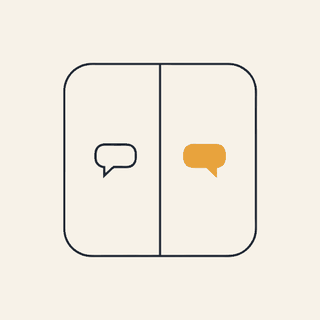
Two languages on one card
The term, the definition and the sentence sit side by side in two languages. The team works in one language and reads the documentation in another — and translation stops being a separate project.

A module, not a library
The unit of delivery is a module on one topic. It’s approved as one package and launches whole. The next one gets added when it’s ready.
Two lines in an email. A draft of your first module back.
Tell us what material you have and who’s going to read it. That’s enough. You’ll get back a draft of the first module — a handful of cards made from your own material. See how it sounds in this format, then decide whether to go on.
- Email. What you have and who it’s for. You get a draft of the module.
- Pilot. A module of 20–30 cards on one topic — in Inkling or in your own app.
- Expansion. More modules, accounts, reporting — inside your perimeter.

- [1] Coursera, "What Is Microlearning?", citing NIH data: about 24% of what was learned remains a month after training.
- [2] Same source: a module of about five minutes; the format’s four benefits — available at any time, holds in memory, easy to update, own pace; the advice to open modules from a phone.